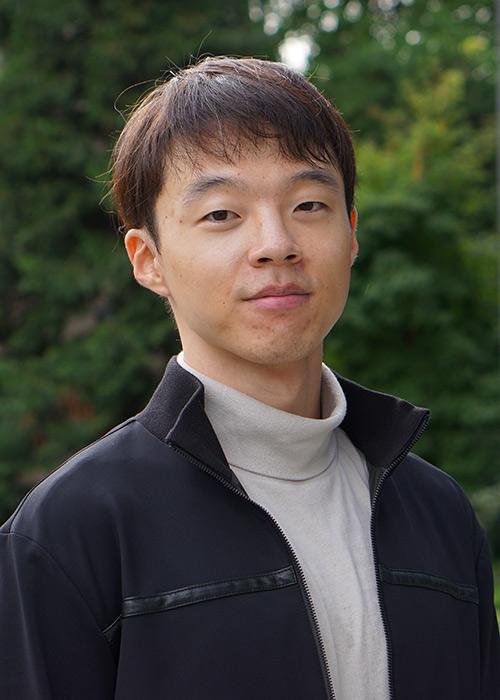
- Hometown: Seongnam, South Korea
- Program & Year: PhD, third year
- More Information: Bumjun's Page
“I study biostatistics because it is a study of what we don’t know. It’s the puzzle of turning the “unknown” to something we can understand, something we can quantify.”
Q&A
What motivated you to pursue a PhD in biostatistics?
My passion for statistics actually started with Moneyball. Seeing how accurate data and statistical reasoning could disrupt the status quo in baseball made me appreciate the true value of statistics. It’s not just about the numbers, it’s about the reason and logic. It’s the backbone of scientific discovery and decision making.
While doing research during my undergrad, I discovered that the health sciences in particular were in great need of trained statisticians. Understanding how toxins spread in our waters, how malaria moves through tropical climates, or how genetic variants link to neurological disorders, fascinating and groundbreaking scientific questions abounded. I kept meeting brilliant researchers who were asking the same thing though: “What can I do with this data that I collected?”
I wanted to be the person who could give them those answers. I wanted to use my passion for statistics to support the people fighting to make the world a better place. And to do that, I realized I wanted to pursue a PhD in biostatistics.
Why UW Biostatistics?
Sometimes, there’s just a sense of affinity for a place that’s hard to put into words. I felt that way about UW Biostatistics when I was first looking at programs, though I couldn’t quite pinpoint why at the time. Two and a half years in, I’m starting to grasp why. At UW, there is a breadth and quality of research, and a genuinely warm and open community.
I came in with various research interests: environmental statistics, Alzheimer’s disease, disease mapping, and more. To my surprise, whatever the topic was, there was someone in our department who I could talk to. Because our faculty collaborate extensively within UW and with other institutions, I’ve been able to delve into practically any area that interests me.
More importantly, there is a tight-knit community here that supports my endeavors. Whether it’s faculty guiding my research or fellow students chatting with me about our research, classes, and lives, there is always someone I can lean on at UW Biostatistics.
How would you describe your experience as a UW Biostatistics student?
They say it takes a village to raise a child. And I say, it takes a department to raise a PhD student. I feel like UW Biostatistics is the perfect embodiment of that.
The open floor design at the Hans Rosling Center makes our department feel incredibly welcoming. When I’m stressing over my research, I can just step away from my desk and walk around. I’ll run into fellow students and start talking about our struggles. I’ll run into faculty and ask them for advice. And when I’m back at my desk, I’m refreshed, recharged, and ready to go again.
That sense of a welcoming community is what makes being a student here special. It has been and always will be a source of motivation for me.
What research are you currently conducting?
I am mainly focusing on three research projects. The first is on Alzheimer’s research. Based on measures of multiple biomarkers, I am investigating how to model the progression trajectory of Alzheimer’s disease and where each person is on that trajectory. Ultimately, we are investigating methods of estimating the degree and rate of disease progression.
The second project is on detection of pollen, with implications for studying the distribution of allergen in our environment. We are studying methods of using a known phylogeny (ancestry tree) of flora to nonparametrically estimate characteristics of pollen from multiple species, from a limited sample.
Finally, I am also studying Bayesian methods for estimating under-five mortality/survival functions particularly in countries with limited data resources.
What are your future plans and have they changed since you started your program?
I have always dreamed of staying in academia. I want to collaborate with different researchers and help answer the many pressing scientific questions we face at this age. During my time here at the department, I gained more interest in teaching as well. Through my interactions with the faculty in the Biostatistics and Statistics departments, I now appreciate more the value of teaching, of training future biostatisticians. In the future, I want to be a collaborative researcher and also a thoughtful teacher.
What advice would you give to a student who is considering the UW Biostatistics PhD program?
My biggest piece of advice would be to embrace collaboration. Within our department, it’s everywhere: from all-day study sessions with your cohort to large-scale research projects with faculty and other departments.
While grades and test scores do matter, I think experiencing and practicing collaborative research will be crucial. Being able to communicate with researchers from different backgrounds and areas of expertise is a skill that will help you greatly when you join the department.
Anything else you'd like people to know about you?
Deciding to move to Seattle was one of the better life decisions I have made. Having grown up in Wisconsin and Korea, moving here was a completely new chapter of my life.
The change of scenery was intimidating at first, but it has been truly rewarding. Between the fresh (and warmer!) air, the new ideas, and amazing people, the move was worth it and then some. I’ve come to appreciate almost every bit of the city (well, everything except for the Seahawks. Go Pack Go!) To anyone nervous about leaving their comfort zone: I’ve been there, and I promise it was worth the leap.


