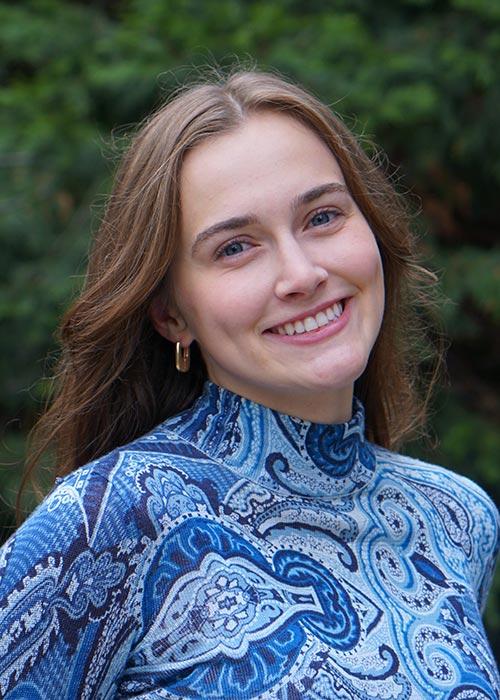
- Hometown: Pinckney, Michigan
Program & Year: MS Capstone, second year
“I study biostatistics because I want to improve the health and well-being of others in and around my community.”
Q&A
What motivated you to pursue a Master of Science (MS) degree in biostatistics?
There have been many moments in my life where I have personally seen the positive impact public health has on a community. After losing my brother to a drug overdose at a young age, I became connected to the harm reduction movement and saw how public health initiatives for drug users improved recovery outcomes. I personally saw the impact public health initiatives like free school lunch had on my and my peer’s ability to succeed in public school. As I waited in line to receive my COVID-19 vaccine at Detroit’s football stadium, Ford Field, which had quickly been converted into a mass vaccine clinic, I saw the power of public health and its direct impact on myself and my neighbors. After receiving a BS in Mathematics, I wanted to find a career where I could incorporate my interest in math and statistics and contribute somehow to improving the health and well-being of others in and around my community. This drove me towards pursuing an MS in Biostatistics. Public health has served me; I feel it’s only fair I return the favor.
Why UW Biostatistics?
The UW Biostatistics program is a consistently top-ranked graduate biostatistics program, nestled in a world-renowned public health school. I knew that if I went here, I would be setting myself up for future success. To be taught by prestigious names in statistics such as Andrea Rotnitzky, Thomas Fleming, Daniela Witten and many more felt like an opportunity I couldn’t pass on. I was also intrigued by the Capstone aspect; I knew with this program’s strong research partnerships, this would give me an opportunity to contribute my skills to impactful research and gain valuable experience. It’d be remiss of me not to also mention how beautiful and fun it is to live in Seattle!
How would you describe your experience as a UW Biostatistics student? What’s been the most valuable part of the experience?
The support you feel from your peers, staff, and faculty here is unmatched. There are so many opportunities to get to know others in the department and participate in activities and decision making. The faculty are some of the most highly regarded minds in the field yet present information in a digestible and understandable way. Another valuable part of this program is the professional development. In the first year I was provided with resume and CV advice, cover letter writing workshops, Github training, professional networking advice, mock interviews, and presentation skill building. This program has provided me with all the skills I need to enter the job market after graduation.
What research are you currently involved with and how does it advance public health?
Before moving to Seattle to get my MS degree, I was working as a data analyst for a syringe service program in Detroit. That ignited a passion in me towards advancing research in prevention and treatment services for people who use drugs. This past summer, I interned with King County Public Health’s Overdose Surveillance team to continue working on advancing treatment research and improving services for people who use drugs. Recently, my research interests have more broadly grown into preventative research which focuses on promoting health outcomes in the public by reducing risk factors, improving quality of life, and implementing evidence-based strategies in at risk communities.
What are your future plans?
I hope to continue in the preventative research field as a collaborative biostatistician in the nonprofit or governmental sector or in a research institute. In the next few years, I am hoping to go back to get a PhD in Epidemiology.
What advice would you give to a student who is considering the UW Biostatistics MS capstone program?
You. Are. Capable. Do not let the “what-ifs” prevent you from going for something you really want in life.


