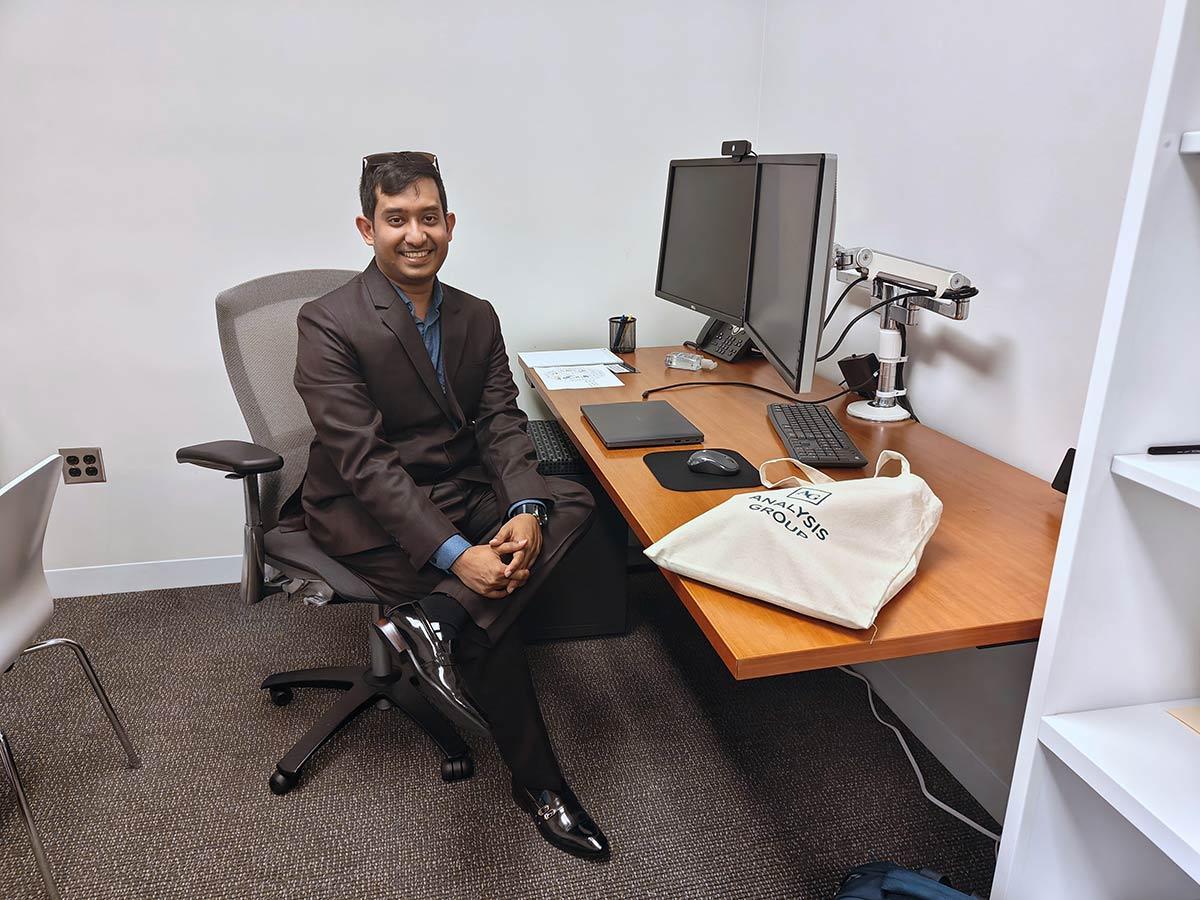
Awan Afiaz
- Program & Year: PhD, fourth year
- Interned with: Analysis Group, Data Science Team as a Senior Data Scientist Intern
Interning with the Analysis Group, an economic consulting firm in Boston, gave Biostatistics PhD student Awan Afiaz the opportunity to connect his academic training with the needs of industry and experience how industry approaches research differently than academia.
While the Analysis Group works primarily on litigation cases, including health care litigation, it recently started developing new analytic products for clients.
As a senior data scientist intern on the Data Science team Afiaz worked on these newer projects, which involved statistical research, machine learning and health care analytics.
His primary project was building a digital twin model that generates model-based patient data. He helped train and validate the model, improve its alignment with real-world data, and develop a statistical estimator to correct for the bias and variance that can arise when working with AI/ML-generated data.
The digital twin project was particularly meaningful to Afiaz because it connected directly to his PhD research on statistical inference with AI/ML-generated data.
“Seeing it come up in a real product, and being able to help with it, was motivating and a good reminder of why the work is worth doing,” he said.
Afiaz also contributed to an internal research project applying graph neural networks to large-scale health care claims data.
Together, the projects gave Afiaz a firsthand insight into how industry and academia approach research differently. Academic research often emphasizes theoretical rigor and addresses edge cases, while industry work prioritizes developing useful solutions, putting them into practice and improving them through iteration.
“One thing I came to appreciate is that to succeed in industry, you need to learn how to fail, and fail fast, rather than getting stuck on a problem. I think it is an important lesson,” said Afiaz.
The internship also underscored the importance of communicating complex statistical ideas to colleagues with different backgrounds and expertise.
“My team members came from very different levels and kinds of academic backgrounds, so explaining concepts, pitching ideas and presenting my work in a way that landed with each person took a lot of care,” said Afiaz.
Afiaz credits the UW Biostatistics program with preparing him to meet these challenges. His PhD coursework in theory and mathematical statistics provided a foundation for tackling new problems, and working as a teaching assistant for several courses gave him experience explaining statistical concepts to diverse audiences. The department’s consulting course also proved valuable, preparing him to develop timely, practical solutions to real-world questions.
“What you will use every day are the fundamentals and your ability to communicate them clearly, so those are the things worth getting really comfortable with,” he said.
Learn more about applying to the Biostatistics PhD program at UW.


