By Kate Stringer
Understanding what causes Alzheimer's and how the disease progresses is like trying to pick out individual voices in a crowded, noisy room. There are so many factors that could be at play – sleep, inflammation, genetics, the microbiome – that making sense of their impact on the disease is challenging.
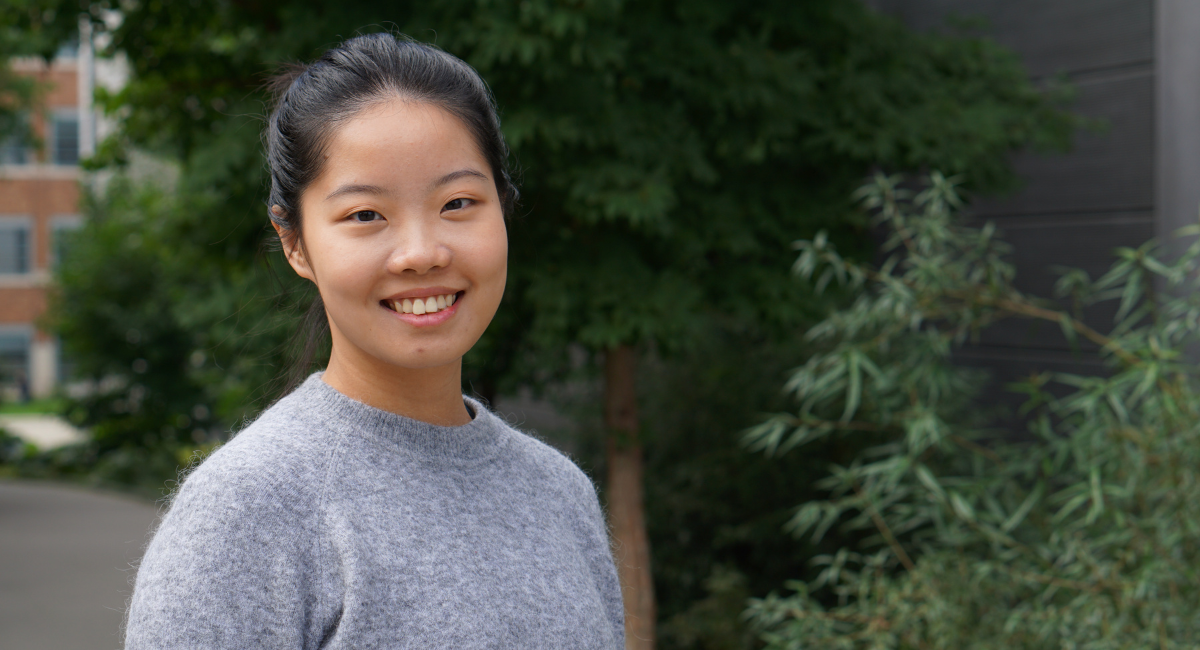
University of Washington master’s student Yifan Lin developed a new tool to help with this. SensGAN is a methodology that uses artificial intelligence and machine learning to help determine which of those factors matter and which can be tuned out.
Lin developed this method for her thesis project as a biostatistics student at the UW School of Public Health. For her novel approach to improving the interpretation of complex genomic data, she was awarded the Gilbert S. Omenn Award for Academic Excellence, one of the most prestigious School-wide recognitions for master’s and doctoral students.
Lin's work will be published in the 2026 proceedings for a premier machine learning conference, International Conference of Machine Learning, alongside her advisor, UW biostatistics Assistant Professor Kevin Z. Lin, developed with support from the UW's Alzheimer's Disease Research Center.
While Lin is interested in understanding Alzheimer’s and dementia, the sensGAN tool is also applicable to other areas of study. Researchers can use this tool to address unmeasured confounding, which are variables that look like they could be causing a result in a study, when really another unaccounted-for variable is at work. This is one of the toughest problems to solve in observational public health research.
Lin compares it to trying to understand what causes lung cancer. Smoking is such a large contributor to lung cancer that understanding if there are other factors that can lead to cancer can be difficult to parse out. A tool like sensGAN can help researchers decipher what variables besides smoking may also be at play, leading to a better understanding of the disease, and cures for it.
“A potential possibility of machine learning or this new technology and engineering method is that you could really scale up your work,” Lin said. “That helps you to model or understand things on a different level, on a much higher level, or a global level even. I think that is an exciting opportunity that my work could potentially bring to public health.”
Lin decided to pursue a master’s degree in the UW Department of Biostatistics after working in the biomedical field on breast cancer diagnosis platforms. This work inspired her to want to better solve public health problems for patients, and to do this she wanted a stronger computational and methodological background.
Lin remembers feeling intimidated at the beginning of graduate school, as people in her classes had strong statistics backgrounds, and she had only taken two statistics classes prior to attending UW. But she soon learned that the unique backgrounds she and her classmates brought to biostatistics made their collaborations stronger. Because she had experience in the biomedical field, she could set up computational simulations with very little effort, and her peers would come to her for help.
“I realized people with unique backgrounds should really value their background, because you are bringing something new to the community,” Lin said. “You might not even realize that, you might feel insecure, but in reality, you have so much to offer.”
During graduate school, Lin also served on the Department’s Student-Invited Speaker Committee. Working on the DEI Mental Health Subcommittee, she co-led their “Be Here Now” initiative, which created space for students, staff, and faculty to have open conversations about mental health and well-being. These events included mindfulness practices, guided meditation, and breathing exercises to support community well-being.
After graduating this year, Lin will pursue a doctoral degree at the University of California, Davis. There, she will use machine learning on genome foundation modeling with plants. Working in a controlled setting, Lin will create models about the relationship between microbes, soil, bacteria, and plants, and will apply those learnings to other settings, like the gut microbiome and how that affects the brain’s function.
“I hope that my current and future work can integrally model public health problems with new areas of technology and science,” Lin said.


